









Specialty Grades
Reactive PVOH Z Series
GOHSENX™ Z Series
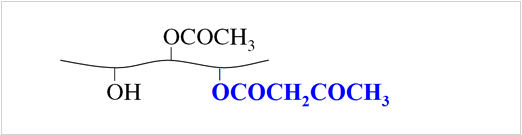
Z Series is a specially modified PVOH containing a reactive acetacetyl group in its molecule.
Structural formula
- Properties
-
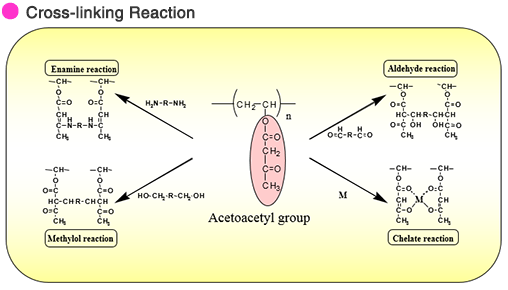
- ・Cross-linked by various methods
- - Adding a cross-linking agent
- - Self cross-linking by thermal treatment
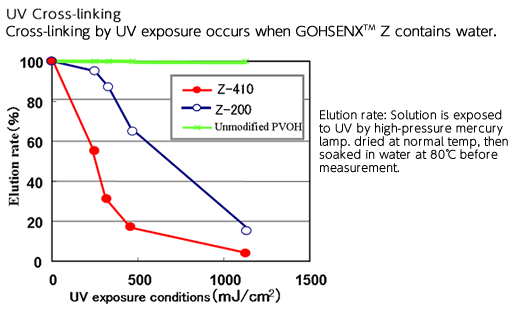
- - UV cross-linking (in a hydrous or aqueous solution state)
- ・Functions as a protective colloid and a surfactant
- ・Adheres well to polarized surfaces
- ・Enables to form chelate
- ・Easy to unchain cross-linking by alkaline
-
| Product Grade | Saponification Value (mol % ) |
Viscosity *1 (mPa・s) |
pH *2 | Volatile Matter ( % ) |
Applications |
|---|---|---|---|---|---|
|
Z-100
|
Min.98.5
|
4.5 - 6.0
|
3.5 - 5.0
|
Max.5.0
|
Thermal recording paper
|
|
Z-200
|
Min.99.0
|
11.5 - 14.0
|
3.5 - 5.0
|
Max.5.0
|
Thermal recording paper, Adhesive
|
|
Z-205
|
Min.99.0
|
11.5 - 14.0
|
3.5 - 5.0
|
Max.5.0
|
Thermal recording paper
|
|
Z-210
|
95.0 - 97.0
|
11.5 - 15.0
|
4.0 - 5.3
|
Max.5.0
|
Emulsifier for vinyl acetate Em
|
|
Z-220
|
90.5 - 92.5
|
11.5 - 15.0
|
3.5 - 5.5
|
Max.5.0
|
Emulsifier for vinyl acetate Em
|
|
Z-300
|
98.0 - 99.0
|
24.0 - 30.0
|
3.5 - 5.0
|
Max.5.0
|
Adhesive
|
|
Z-320
|
92.0 - 94.0
|
19.0 - 24.0
|
3.5 - 5.0
|
Max.5.0
|
Water based vinyl urethane
|
|
Z-410
|
97.5 - 98.5
|
43.5 - 58.5
|
3.5 - 5.5
|
Max.5.0
|
Adhesive
|
*1. 4% aqueous solution at 20℃
*2. 4% aqueous solution at 30℃
Applications of GOHSENX™
- Emulsifier
- Water resistant bonding strength EM will be produced by using Gohsenx™ Z as emulsifier for vinyl acetate EM compared with conventional PVOH.
- Coating Agent
- Gohsenx™ Z is applied as coating agent for thermal printing paper, ink jet printing paper and so on, as increasing demand for coated and non-coated paper which require water resistant strength.
- Adhesive and Binder
- Gohsenx™ Z can use as adhesive and binder since excellent adhere and water resistance.
Recommended crosslinker(Sefelink™ SPM-01)
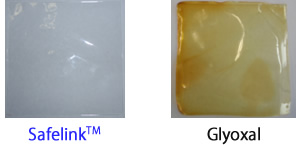
Safelink ™ SPM-01 is a new crosslinking agent for Gohsenx™ Z developed by our own technique. Both type of powdered and 10% aqueous solution are available.
- Characteristics
-
- ・Excellent crosslinkability for Gohsenx ™ Z.
- ・High safety with less toxicity compared to other crosslinking agents
- ・Easy handling with longer pot life after mixed with Gohsenx Z.
- ・Excellent color stability against heat and aging conditions.
| Cross-linking Agent | |||||
|---|---|---|---|---|---|
| Amount (parts) |
pH | Elution rate(%) ※1 |
Pot life ※2 |
YI ※3 |
|
| Safelink™ SPM-01 | 5 | 5.0 | 3 | More than 7days |
4 |
| Glyoxal | 1 | 4.4 | 6 | 7days | 12 |
※1. Dry film (heat treated for 5 min at 70℃) after soaking in 80℃ water for 1 hr.
※2. Period of reaching viscosity of 7% aqueous solution to twice at 23℃.
※3. After 100μm film left for 7 days at 40℃, 90%RH. (NIPPON DENSHOKU ∑90)
| Crsslinking agent | Product name | Chemical name | Product company | Add- intion *1 |
pH | Elution rate (%) *2 |
Pot Life (hr) *3 |
|---|---|---|---|---|---|---|---|
| Amine | MXDA | Methaxylenediamin | MITSUBISHI GAS CHEMICAL COMPANY, INC. | 3 | 10.5 | 20 | 0.1 |
| 1, 3-BAC | 1,3-bis (aminomethyl) cyclohexane |
3 | 10.5 | 20 | 0.1 | ||
| Hydrazide | ADH | Adipoyldihydrazide | Otsuka Chemical Co., Ltd. | 3 | 5.4 | 1001) | 0.1 |
| APA-280 | 3 | 5.4 | 15 | 0.1 | |||
| Aldehyde | SEQUAREZ 755 | Polyol Carbonyl Adduct |
OMNOVA Solutions Inc. | 3 | 4.3 | 10 | 9 |
| Metal Salt | ZIRCOZOL ZC-2 | ZrO(OH)Cl·nH2O | DAIICHI KIGENSO KAGAKU KOGYO CO., LTD. | 3 | 1.9 | 3 | Min.168 |
| ZIRCOZOL AC-7 | (NH4)2ZrO(CO3)2 | 3 | 4.8 | 202) | Min.168 |
*1 : Additive volume(Parts) / Z-200
*2 : After soaking dry film pretreated 70℃ × 5min in 80℃ water for 1hr
*3 : Measure period until 10% aqueous solution viscosity would be twice than initial viscosity as
40℃
1) : insoluble in cold water
2) : Elution rate at 90℃
| Emulsion NO. | 1 | 2 | 3 | 4 | |
|---|---|---|---|---|---|
| Polymerization Recipe | Z-210 (parts) | 4 | - | - | - |
| Z-220 (parts) | - | 3 | - | - | |
| N-300 (parts) | - | - | 5 | - | |
| GM-14 (parts) | - | - | - | 3 | |
| Vinyl acetate (parts) | 36 | 37 | 45 | 47 | |
| Water (parts) | 60 | 60 | 50 | 50 | |
| Polymerization Iinitiator | APS | APS | HPO/TA | APS | |
| Properties | Evaporation Residue (%) |
40 | 40 | 50 | 50 |
|
Viscosity |
15,600 | 27,300 | 13,000 | 53,000 | |
| pH | 4.3 | 4.2 | 4.5 | 4 | |
| Apparent Graft Ratio (%) |
76.1 | 76.1 | - | 42.3 | |
| Freeze-thaw Stability (number of cycles) |
5< | 5< | 0 | 5< | |
| Water-proof Adhesion Test |
13hrs | 95hrs | × | × |
NOTE
(1)APS:Ammonium peroxosulfate
(2)Apparent graft ratio: An emulsion film was air-dried at 20℃, treated with acetone at 40℃ for 8 hrs
and with hot water at 80℃ for 8 hrs, and the extraction-residue was calculated.
(3)In the water proof adhesion test, 100g/m2 of emulsion was applied to each face of birch
specimens. The specimens were then glued together and pressed for 24 hrs at 200 gf/cm². After
depressurizing, the resultant sample was left to stand for 24 hrs. This sample was used as a test piece.
The test piece was immersed in boiling water and the time needed for the bonded faces to come apart was
measured.
| Mixing Ratio | Emulsion Properties | G.f (%) |
|||
|---|---|---|---|---|---|
| Viscosity (mPa・s) |
S.V.I | Solids (%) |
|||
| Z-200 : 4 parts |
Initiator(APS) : 0.08 parts |
12,000 | 0.5 | 40 | 73 |
| VAC : 36 parts |
Buffer(NaOAc) : 0.02 parts |
||||
| Pure water : 60 parts |
|||||
| Z-100 : 45 parts |
Initiator(APS) : 0.08 parts |
2,300 | 0.3 | 50 | 69 |
| VAc : 45 parts |
Buffer(NaOAc) :0.02 parts |
||||
| Pure water : 50 parts |
|||||
Viscosity: Brook field viscometer, 10 rpm, 25℃
S.V.I: Obtained by log (viscosity at 2.5 rpm/viscosity at 20 rpm) ÷ 0.903
Solids: Obtained by drying samples for 3 hrs. at 105℃
G.f(%): Grafting ratio
An emulsion film was air-dried at 20℃, Treated with acetone at 40℃ for
8hrs and with hot water at 80℃ for 8hrs,
and the extraction-residue was calculated.
cf) G.f of GM-14 use Em. (55% solids) is 40-50%.
Dissolution and Storage
- Dissolving GOHSENX™ Z
- Put GOHSENX™ Z into room temperature water while stirring the water. Heat the water immediately while constantly and continuously stirring the water, and keep it at 90℃ to 95℃ for 30 to 60 minutes until complete dissolution.
- Storing GOHSENX™ Z
- The properties of a GOHSENX™ Z aqueous solution may change (e.g. its viscosity may increase) if stored for a long period of time. Color changes or viscosity increase may also be induced by rust or metallic ions entering the solution.
- Note
-
- ・When mixing GOHSENX™ Z with defoaming agents, anticorrosives, antiseptics, or other chemicals, follow the handling instructions of these chemicals.
- ・Avoid storage in a hot, humid area as the product may incur blocking or its properties may change.
- ・GOHSENX ™ Z is stable when stored at moderate temperature; however, GOHSENX ™Z has a functional group that makes the product chemically quite reactive, and contamination of other chemicals may cause the product to become insoluble or form gel.
| Polymer | COD (mg/kg) ×104 | BOD5 (mg/kg) ×102 |
|---|---|---|
| GOHSENX™ Z | 99 | 70 |
| GOHSENOL™ | 60 - 100 | 50 - 100 |
| Corn Starch | 36 | 7,400 |
Measuring conditions: Sample conc. mean pure material conc.
COD was measured by potassium permanganate method (JIS K 0102), and BOD5 is a 5-day BOD value.
Measurement: Registration No. of measurement certification enterprise, Osaka No. 10013, KK Osaka
Environmental Technology Center.