









Technical Information
Polymerization and Saponification Value of GOHSENOL™ Products
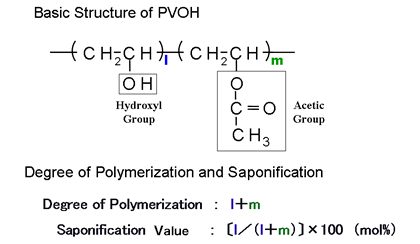
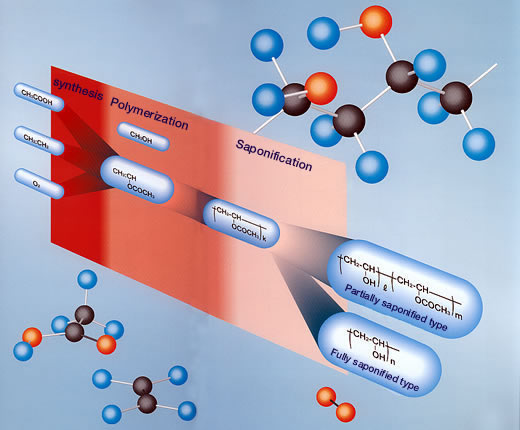
GOHSENOL™ products can be roughly categorized into two types; a fully saponified type comprising
mostly hydroxyl groups, and a partially saponified type retaining a certain portion of acetic
groups.
The relation between the fully saponified type and partially saponified type can be illustrated as
below.
|
Polymerization degree is usually indicated as a viscosity at a particular concentration (usually, 4% at 20℃).
| Degree of Polymerization | ||
|---|---|---|
| Higher | Lower | |
| Solution Viscosity | Higher | Lower |
| Film Strength | Stronger | Weaker |
| Solubility | Less water-soluble | More water-soluble |
| Saponification Value | ||
|---|---|---|
| Higher | Lower | |
| Solution Viscosity | Somewhat higher | Somewhat lower |
| Film Strength | Slight stronger | Slight weaker |
| Solubility | Less soluble in cold water | More soluble in cold water |