









Specialty Grades
Low Saponification PVOH LL Series
GOHSENX™ LL Series
A low degree of saponification PVOH that hardly dissolves in water.
GOHSENX™ LL dissolves in organic solvents and mixture solutions.
GOHSENX™ LL is used worldwide as a hot melt adhesive, providing the property of melting at
relatively low temperatures, besides suspension aids for vinyl polymerization.
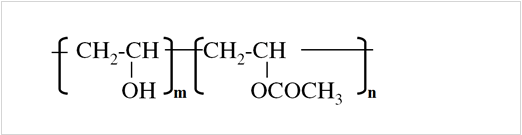
Structural formula
- Properties
- Dissolves in organic solvents such as methanol, ethanol, methyl acetate, and acetone, and aqueous
mixture solution.
Melts at 100℃ to 180℃ and allows hot melt coating and adhesion.
|
Grade
|
Volatile
Matter |
Viscosity
(mPa・s) |
Saponification Degree
(mol% ) |
Applications
|
|---|---|---|---|---|
|
LL-810
|
3.0 or less
|
7.0~10.0
|
45.0~51.0
|
Secondary dispersant for suspension
polymerization of vinyl chloride,
Adhesive (hot-melt), Binder, Anchor coating agent |
|
LL-920
|
3.0 or less
|
9.0~13.0
|
30.0~38.0
|
|
|
LL-940
|
3.0 or less
|
20.0~28.0
|
34.0~41.0
|
Viscosity: mixture solution of 10.0% methanol and water (1/1, volume ratio)
| Solvent | LL-810 | LL-920 | LL-940 |
|---|---|---|---|
|
Water
|
△
|
△
|
△
|
|
Water/Methanol = 1/1
|
◎
|
◎
|
◎
|
|
Methanol
|
○~△
|
○
|
○
|
|
Ethanol
|
○~△
|
○
|
○
|
|
Acetone
|
○~△
|
○
|
○
|
|
Methyl acetate
|
△
|
○
|
○
|
|
Toluene
|
×
|
×
|
×
|
|
Trichlene
|
×
|
△
|
△
|
Solubility (High) ◎>○>△>× (Low)
|
Grade
|
Initial Young's
Modulus (109dyne/cm2) |
Yield
Strength (kg/cm2) |
Rupture
Strength (kg/cm2) |
Elongation
(%) |
|---|---|---|---|---|
|
LL-810
|
Approx 4.5
|
112
|
126
|
130
|
|
LL-920
|
Approx 5.0
|
125
|
140
|
145
|
|
LL-940
|
Approx 10.5
|
270
|
219
|
45~160
|
Measuring conditions
Film: 150~200μ×40mm×15mm
Humidity: 20℃×65 % RH×7days
Tensile speed with autograph, 100mm/min, 7 cycles
| LL-810 | LL-920 | LL-940 | ||
|---|---|---|---|---|
| Incipient Fluidization Temperature (℃) |
Approx. 100
|
Approx. 100
|
Approx. 110
|
|
| Incipient Fluidization Viscosity (poise) |
150
|
300
|
4,000
|
|
| Decomposition Temperature (℃) |
250 or higher
|
250 or higher
|
250 or higher
|
|
| Grass Transition Point (℃) |
Approx. 50
|
Approx. 50
|
Approx. 45
|
|
Measuring conditions:
Koka flow tester
Load 20kg/cm2, heat increase rate 1℃/min, Orifice dia 1m/mΦ×10m/mL
- Other Precautions
- GOHSENX™ LL series is a stable polymer compound, and does not usually putrefy, decompose, or
depolymerize.
However, owing to its lower glass transition point, the particles conglomerate when stored at high temperature / humidity and under a heavy load. Keep the above in mind especially storage in sumer or rainy seasons.